Does this example represent a universal construction price?
No. The numbers and structure are illustrative. Market rates, taxes, labor, equipment and supplier conditions vary by place and project.
Worked example guide
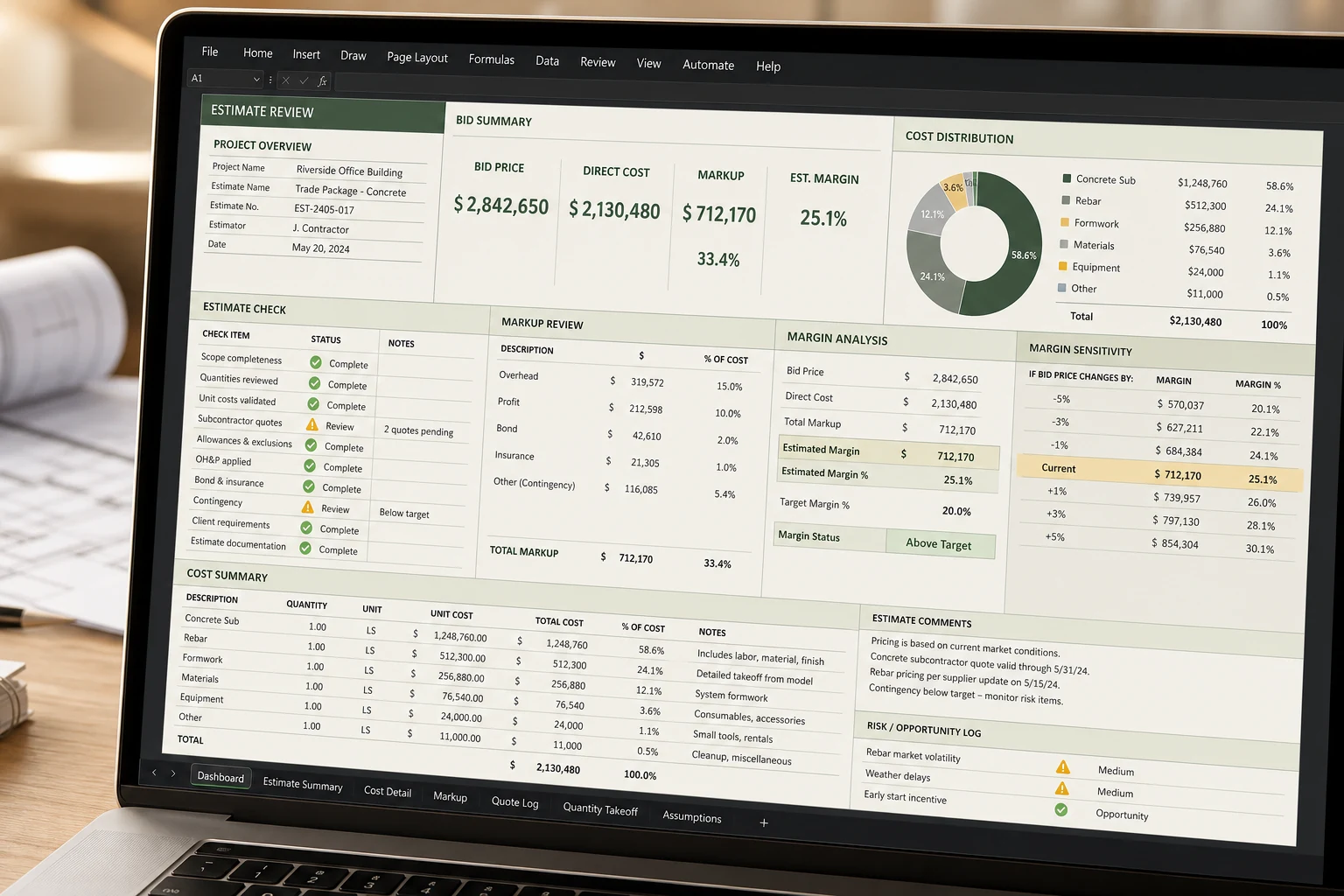
This example shows what a practical construction estimate looks like when project setup, line items, labor, equipment, contingency and markup are kept visible instead of buried inside one final number.
Imagine a small contractor pricing a simple concrete slab job for a light commercial or residential-use outbuilding. The scope includes basic site prep, formwork, reinforcing, concrete placement and cleanup. The point is not to claim one universal price. The point is to show how the estimate is structured so the price is traceable.
Before any line-item pricing, the estimator defines the project name, client, location, estimate date, basic scope and key commercial assumptions. This is also where tax handling, contingency approach and markup logic should be decided. If those decisions are postponed, the estimate often becomes a patchwork later.
| Category | Example content | Why it is visible |
|---|---|---|
| Materials | Concrete, reinforcing, forms, vapor barrier, consumables | Supplier-driven cost should not disappear inside a generic allowance. |
| Labor | Layout, setup, forming, pour day, finishing, cleanup | Labor needs quantity and rate logic, not only a lump sum guess. |
| Equipment | Compaction, saw, mixer support, small machinery as needed | Company-owned equipment still needs recovery. |
| Other direct costs | Disposal, delivery, mobilization support, permit-related items | These costs often get lost if the estimate is too compressed. |
In a better estimate, labor is not just wage and equipment is not treated as free because it is already owned. The estimator should know whether labor includes taxes, benefits and non-billable time, and whether the equipment number actually reflects use and recovery. If not, the estimate can still look polished while the cost base stays weak.
That is why this example connects naturally to the labor burden guide and the equipment rate calculator.
Project-specific supervision, temporary protection, access support or other general conditions should not be blurred into markup by accident. A clearer example keeps direct cost, indirect job cost and broader commercial recovery separate enough to review. If you need the logic behind that split, use the direct vs indirect cost guide.
If the example job still has uncertainty around access, hidden conditions or quantity assumptions, contingency can be shown as its own line or allowance. It should not be used to hide weak labor rates or missing equipment cost. That is why contingency belongs after the estimate structure is clean, not before.
Once direct cost, indirect cost and contingency are visible, markup becomes a real pricing decision instead of a rescue percentage. In this example, the estimate moves from cost build-up into a final bid price that can be checked against target margin. That is the bridge between an internal estimate and a client-facing offer.
If you want a cleaner checklist for that final output, use the contractor bid guide.
Most people searching for a construction estimate example are not just looking for a PDF they can copy visually. They are trying to understand what a believable estimate looks like when the pricing logic is organized properly. A worked example helps connect the theory to a real workbook flow. If you want to stress-test the example afterward, use the estimate mistakes guide.
No. The numbers and structure are illustrative. Market rates, taxes, labor, equipment and supplier conditions vary by place and project.
Because categories make the estimate easier to review, easier to revise and easier to compare against actual job cost later.
Yes. That is exactly the point of a workbook-driven estimate process: the example becomes a repeatable structure instead of a one-off sheet.
Related next steps
See the construction estimate template guide for tabs, structure and review flow.
Read the markup guide and the contingency guide.
The Contractor Estimate Starter Pack turns this kind of estimate flow into an editable workbook.
From example to reusable file
The starter pack keeps setup, estimate lines, review and proposal flow connected so the next bid starts from a cleaner baseline.
See the starter pack