Is labor always a direct cost?
Field labor usually is. Office admin labor usually is not. Project-specific supervision may sit in its own bucket depending on how your estimate is structured.
Estimate structure guide
A construction estimate gets harder to trust when labor, equipment, supervision, office recovery and risk are all mixed together. Separating direct and indirect cost gives contractors a clearer path from field production to final bid price.
Direct costs are the costs tied to performing the specific job or scope item being estimated. In most contractor estimates, that means labor, materials, equipment, subcontractors, trucking, disposal, permits and other project-specific expenses that would not exist if the job did not exist.
The simplest test is this: if the project disappears, does that cost disappear too? If yes, it usually belongs in direct cost.
Indirect costs are the costs that support the job or the business but are not tied neatly to one production line item. Depending on company structure, these can include project management recovery, office support, estimating time, accounting, insurance, vehicles, small tools, general conditions and other overhead-like items.
The challenge is that different contractors use the same words in different ways. Some companies treat general conditions as direct job cost. Others treat them as indirect recovery. The important thing is not the label alone. The important thing is keeping the logic consistent.
| Bucket | Usually includes | Why it matters |
|---|---|---|
| Direct cost | Labor, material, equipment, subs, freight, disposal, permits, field production support | This is the core cost of doing the work. |
| Indirect job cost / general conditions | Supervision, temp facilities, temporary protection, site admin, mobilization, traffic control, project-specific management | These items often belong to the job, but not to one single production line. |
| Company overhead | Office payroll, rent, software, accounting, owner admin time, broad insurance, business vehicles | These items need recovery somewhere, but hiding them randomly inside line items weakens estimate review. |
| Contingency and profit | Risk allowance, uncertainty coverage, target profit | These are pricing decisions, not the same thing as production cost. |
General conditions often cause the most confusion. They are not always pure overhead. If a superintendent, temporary fencing, layout support or site trailer exist only because this project exists, many estimators treat them as job-specific indirect cost or general conditions. That can be perfectly reasonable.
The key is to decide whether these items are being priced as visible job cost or being recovered through markup and overhead. What you want to avoid is recovering them twice or, worse, not recovering them at all.
Markup works best when the cost base underneath it is honest. If labor burden is missing, if equipment recovery is buried in miscellaneous, or if project supervision has no clear home, the markup percentage starts doing too much work. Then the estimate becomes harder to explain because the markup is compensating for structural confusion.
That is why many contractors first clarify direct cost, indirect job cost and overhead recovery, then decide whether uncertainty deserves a visible contingency allowance, and only then use the markup guide or the markup vs margin calculator to set final price deliberately.
Suppose a small concrete job contains direct labor, materials, equipment and disposal totaling $18,500. The job also needs one project-specific supervisor visit sequence, temporary protection and mobilization totaling $2,200. The company still needs broader office recovery beyond that. In a cleaner estimate structure, the first group stays in direct cost, the second group is shown as indirect job cost or general conditions, and the broader company recovery is handled intentionally through overhead allowance or markup policy.
That structure is much easier to review than dumping everything into one direct-cost line and then applying a large markup that no one can decode later.
Separating cost buckets in the estimate also improves the comparison against actual job cost later. If everything is blended together, you cannot tell whether the job missed because labor was too light, supervision was underestimated, equipment recovery was weak or overhead was over-assumed. Better estimating structure leads to better learning after the job closes.
Field labor usually is. Office admin labor usually is not. Project-specific supervision may sit in its own bucket depending on how your estimate is structured.
They are often treated as indirect job cost or a separate visible estimate section. The important point is to keep them intentional and consistent, not hidden.
Either can work. Many contractors use a hybrid approach: visible project-specific indirect cost plus broader company overhead recovered through allowance or markup policy.
Related next steps
Read the labor burden guide before direct cost is understated.
Use the markup guide and the markup calculator after the cost buckets are separated.
The Contractor Estimate Starter Pack helps keep setup, direct cost, review and pricing logic in one file.
From concept to worksheet
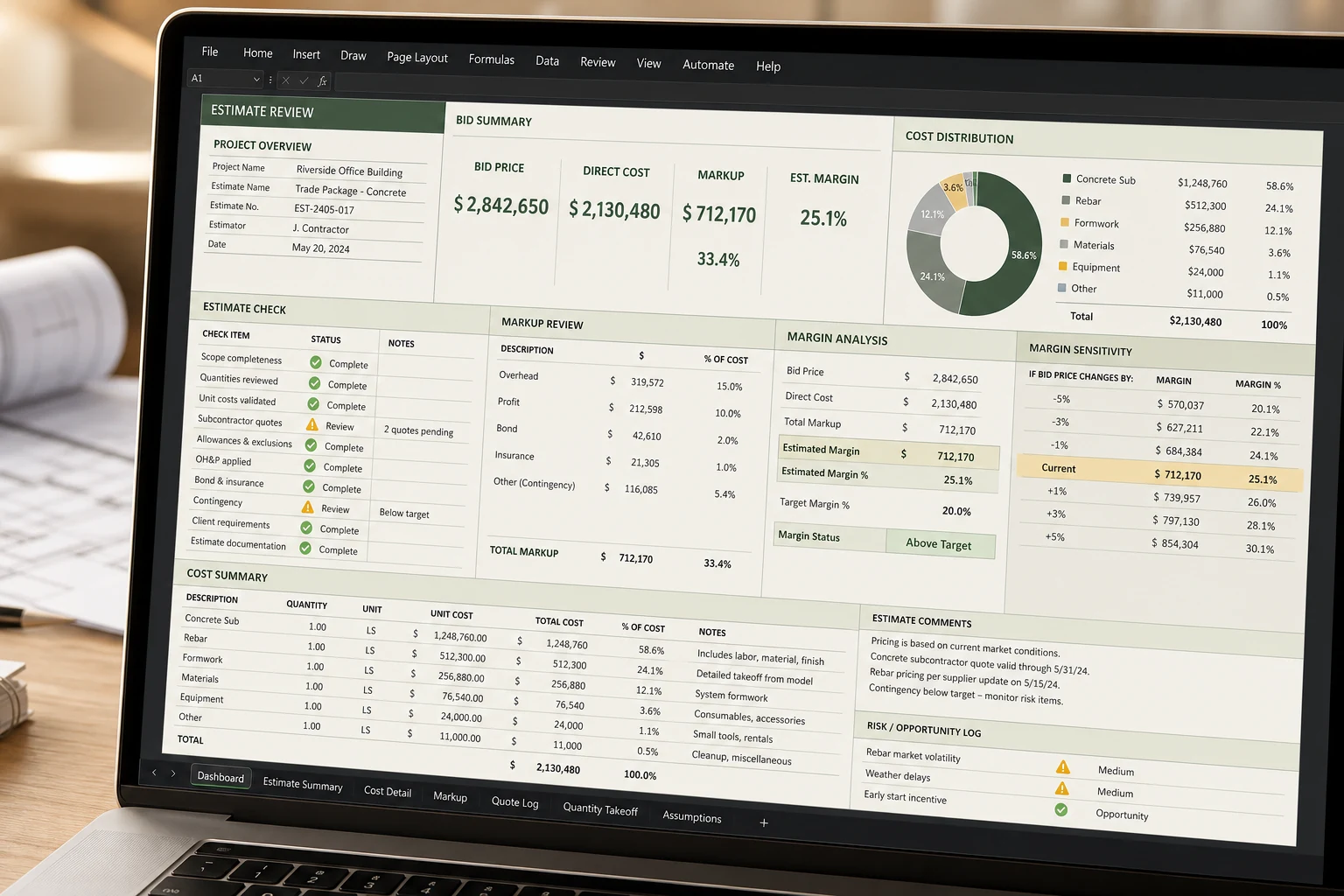
The starter pack gives direct cost, labor, equipment, markup review and proposal output separate places to live, so pricing decisions are easier to understand and defend.
See the starter pack